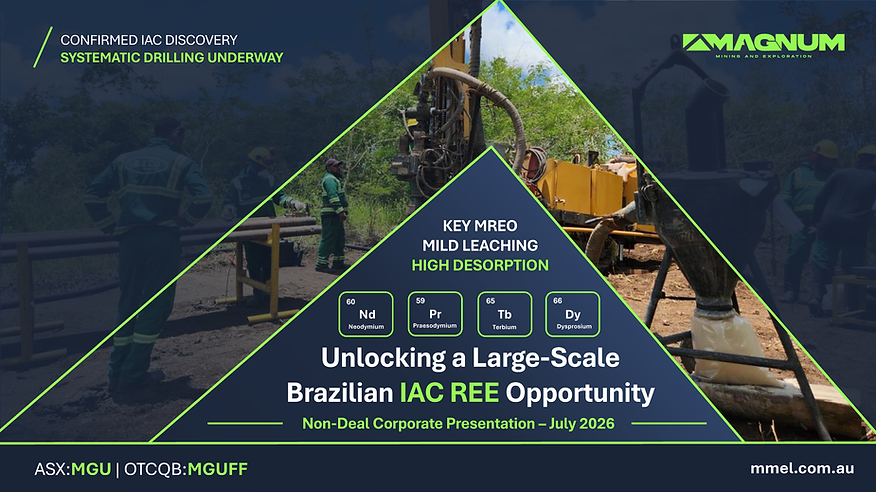
The World Needs What's Beneath Brazil.

Magnum Mining and Exploration is an ASX and OTCQB-listed company advancing rare earth and critical mineral projects in Brazil — where geology, jurisdiction, and timing converge.

The global race to secure rare earth supply chains outside China has created a defining investment window. Magnum is advancing high-impact exploration programs across Brazil and the United States, with a disciplined approach to creating shareholder value and supporting Western supply chain security.

ASX: MGU   |   OTCQB: MGUFF

The Rarest Opportunity in Critical Minerals.

China controls approximately 90% of global rare earth processing. In 2025, export restrictions on key heavy rare earth elements sent shockwaves through automotive, defense, and clean energy supply chains across the US, Europe, and Asia.


Western governments responded with billions in strategic investment — but the supply gap remains acute. The world urgently needs new, reliable sources of rare earth elements outside China’s influence.


That’s where Brazil — and Magnum — come in.

Why This Moment Is Different

China's 2025 export controls on seven heavy REEs triggered immediate supply chain disruptions globally

The US, EU, and Australia have launched billion-dollar programs to fund REE projects outside China

Global REE demand is projected to increase by more than 60% by 2040 (IEA)

Brazil holds significant rare earth and ionic clay deposits — and Magnum holds key exploration licenses

The window for positioning in this sector is now. Early-stage projects with strong geology and regulatory access represent significant upside.

Where Experience and Opportunity Converge.

Magnum Mining and Exploration is an Australian-founded mineral exploration company listed on the ASX and OTCQB, with over two decades of experience in mineral exploration and project development.

Having identified Brazil as a strategic frontier for rare earth elements and ionic clay deposits, Magnum expanded its operations to South America — securing exploration licenses in regions with high geological potential and favorable regulatory frameworks.

Our focus: rare earth elements (REE), ionic clay, and critical minerals that power the technologies of tomorrow — from electric vehicles and wind turbines to defense systems and advanced electronics.

Our Approach

Exploration-Led. High-Impact. Across the Americas.

Magnum has a wholly-owned, Americas-focused portfolio spanning rare earth elements, copper, and gold — with large-scale drilling underway in Brazil and high-grade projects in the United States advancing towards drill targeting.

Why Choose Us?

In a sector where timing, jurisdiction, and technical credibility define outcomes, Magnum offers a differentiated proposition for institutional and strategic investors

01

Strategic Asset Positioning

Wet Mountain presents a compelling rare earth opportunity in Colorado, anchored by outcropping carbonatite REE mineralisation and a large geophysical footprint — with no modern drilling yet completed, leaving significant discovery upside untested.

02

Proven Exploration Team

More than 20 years of mineral exploration experience across multiple jurisdictions. A management team with the technical credibility and international networks required to advance projects from exploration through development.

03

Dual-Listed, Transparent Structure

Magnum is listed on the ASX (Australia) and OTCQB (United States), providing investors with a regulated, transparent vehicle for exposure to the critical minerals sector — with the governance standards expected by institutional capital.

04

Ionic Clay Advantage

Ionic clay deposits represent one of the most cost-efficient pathways to rare earth extraction. Unlike hard-rock mining, ionic clay REE extraction typically requires simpler processing, lower capital intensity, and reduced environmental impact — a meaningful differentiator in a capital-sensitive sector.

05

Macro Tailwinds

The geopolitical imperative to diversify REE supply chains outside China is accelerating. Western governments have committed billions to fund exploration and development of non-Chinese critical mineral projects. Magnum is positioned directly in the path of that capital flow.

Position Yourself in the Critical Minerals Supply Chain.

The global transition to clean energy and advanced technology cannot happen without rare earth elements. The companies and investors who move early — with the right projects, in the right jurisdictions — will define the next decade of the critical minerals sector.Magnum is advancing that opportunity in Brazil. We invite institutional and strategic investors to explore our projects, review our corporate materials, and connect with our team.

Frequently Asked Questions.

No single number tells the story — eight complementary factors are building the exploration case: repeatable anomalous TREO results, multiple emerging target centres, encouraging preliminary desorption, exposure to magnet and heavy rare earths, an expanding geophysical footprint, a six-rig exploration programme, favourable infrastructure and near-term technical milestones.

Four themes carry the most weight: repeatability, desorbable magnet-REE value, scale potential and execution capability. Together, they explain why Magnum is systematically testing Piracanjuba North for lateral and vertical continuity. The project remains at exploration stage — further work is required to establish a Mineral Resource and economic significance.

TREO tells us how much total rare earth oxide is present — but in an ionic-clay system, value depends on more than grade. It depends on how much can be released from the clay under test conditions, which elements make up that desorbable fraction, and whether the response shows enough thickness, continuity and scale.

The relevant indicators include the desorbable rare earth fraction, magnet REEs — especially NdPr and DyTb — repeatability across the weathering profile, potential scale and the processing pathway. Desorption screening indicates potential extractability under mild, unoptimised laboratory conditions; it is not commercial recovery or proven economics.

Repeatability sits at the heart of the Piracanjuba North story. All 122 holes reported to date returned anomalous TREO values across multiple areas, and most holes in the second assay batch closed on anomalous REE grades. Selected intervals also returned encouraging desorption-screening responses for total, magnet and heavy rare earths under mild, unoptimised conditions.

For investors, that reduces reliance on any one exceptional hole. The next proof points include coherent geological domains, thickness, lateral and vertical continuity, mineralogical controls, QAQC and reproducible desorption. Encouraging — but not yet a Mineral Resource or proven economic extraction.

As at 30 June 2026, the programme had completed 3,251.1 metres across 314 collars — 32.5% of the planned ~10,000 m programme — with six rigs active: four mechanised augers, one deeper-capacity auger and one diamond rig.

This is a ramp-up in drilling capacity, not mineral production. It increases lateral coverage, data density and deeper testing of the weathering profile, building the geometry, continuity, mineralogy, metallurgy and QAQC needed to support a potential Exploration Target and, subject to results and further technical work, a maiden JORC Mineral Resource estimate.

A geological discovery is easier to advance when access, people, services and infrastructure are already nearby. Piracanjuba North sits approximately 7 km in a straight line from Piracanjuba city and about 93 km by road from Goiânia. The regional setting brings established road access, electricity infrastructure, service centres, workforce availability and proximity to a major city and airport.


Location is an advantage, not proof of development economics: power capacity, connection costs, permitting requirements and infrastructure needs must still be confirmed through engineering and feasibility work.